Designing for Agents

You designed for someone watching. Now nobody is.

50 patterns for agents. The weight sits on trust.

If you have designed AI features before, you have a pattern set already — and roughly a third of it does not travel. The controls you know assume a person is present while the model works. Agents run while that person is in a meeting, which moves the design problem from steering the work to trusting what came back from it.

What Changes

Control that needs your hand on it does not survive delegation.

Thirty of the 80 patterns in this catalog stop working once the operator leaves the loop, and they are not scattered at random. Fourteen of the sixteen Inline & Contextual patterns fall away, and nine of the fourteen Visual & Generative ones. Those are the two most chat-native families in the library.

Stays behind

Steering at the moment of the act.

Every one of these puts your hand on the thing while it happens. Drag the slider, watch it change. Select the text, transform it. That mechanism needs a person present, and presence is exactly what delegation removes.

Travels

Steering you set up, or that comes to you.

Directability does not disappear — it changes tense. What survives is either configured before the run starts, or interrupts you during it. Neither asks you to be sitting there.

The tell is in the lifecycle tags: 63% of the agent-ready patterns sit at processing or trust — the stages that happen without you — against 13% of the rest.

Where the Weight Moves

Trust stops being a virtue and becomes a control surface.

While you were watching, trust was cheap — you saw the work happen. Take the watching away and every question you used to answer by looking has to be answered by the interface instead.

Trust & Verification is the category that carries that load: 15 of its 17 patterns are agent-ready, second only to Agent Workflow at 17 of 18. Those two are the agent end of the catalog. Inline & Contextual runs the other way — two of sixteen.

That is the shape of the work. If you are designing an agent product and your pattern vocabulary is mostly inline and generative, the vocabulary is the thing to change first.

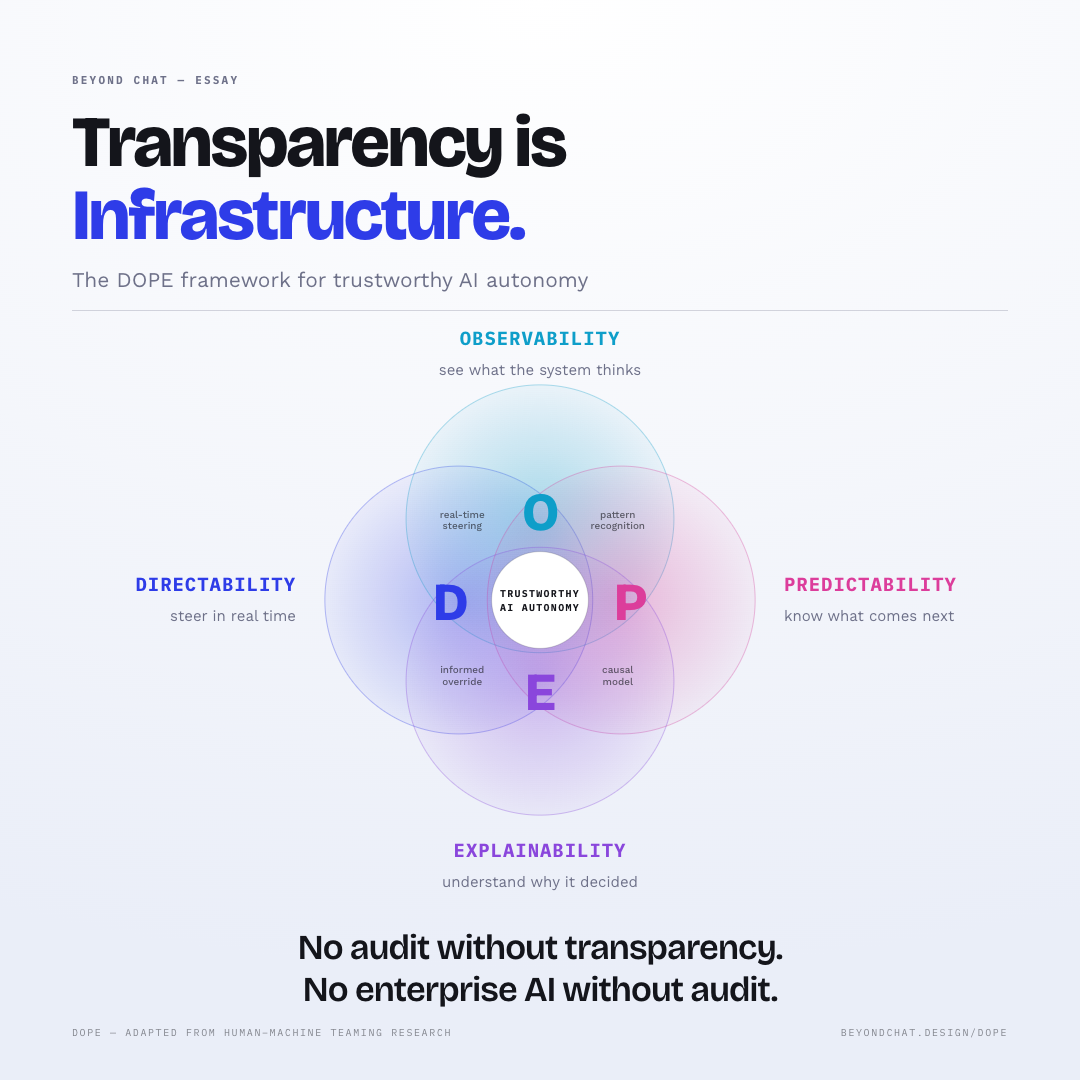
Transparency is Infrastructure

From the Essay

Transparency is infrastructure — the DOPE framework for trustworthy AI autonomy.

Read “Transparency is Infrastructure”

The Set

Nine patterns, grouped by the question they answer.

Each is a working demo, not a description. The grade beside each one says how much of it actually ships today — mature means a named product does the whole move, emerging means the distinguishing half is still missing everywhere.

These nine are the entry points, not the whole set. Trust & Verification has seventeen, and Agent Workflow another twenty — the catalog filters by DOPE axis, lifecycle stage and agent-readiness, so you can pull the slice that matches what you are building.

What This Rests On

Not a point of view. A reading list.

Twenty-nine academic and industry sources inform this catalog, and twenty-two of them touch agent work. Each pattern page names the ones behind it, so you can go past the pattern to the paper.

Guidelines for Human-AI Interaction

Amershi et al., Microsoft Research · CHI 2019

Reasoning Trace · Capability Boundary · Model Changelog

People + AI Guidebook

Google PAIR, 2021

Confidence Signals · Citation Trail · Capability Boundary

Information Foraging with Generative AI

CHI 2023

Disambiguation Branch · Citation Trail · Confidence Signals

Intelligent AI Delegation

Tomašev, Franklin, Osindero · Google DeepMind, 2026

Verifiable Completion · Cognitive Friction · Authority Gradient

Overseeing Agents Without Constant Oversight

UW + Microsoft Research, 2026

Oversight Rhythm · Concurrency Dial

Cocoa: Co-Planning and Co-Execution with AI Agents

AI2 + University of Washington, 2024

Live Plan Surface · Editable Plan

How This Is Labelled

You should know which of these you would be pioneering.

Agent design writing rarely says whether anyone has actually built the thing it recommends. Every pattern here carries a grade for that, so adopting one is a different decision from inventing one. The honest headline is that the agent-relevant end of the catalog is the thinner end: of the 50 agent-ready patterns, fifteen have a shipped instance. That is where the field is, not a flaw in the list.

Mature

28 of 80

A named product does the whole move. Adopt it.

Emerging

40 of 80

Part of it ships. The distinguishing half is yours to design.

Aspirational

12 of 80

Nothing ships it yet. The source is a paper or a protocol.

Citations re-verified 2026-05 · 2026-07 · 2026-08

The move is small enough to carry: your controls assumed someone was watching. Design the interface that answers, afterwards, the questions that person used to answer by looking.

Beyond Chat and the DOPE framework — Directability, Observability, Predictability, Explainability — are written and maintained by Dominik Witzke, alongside the Analytical Resonance series. Counted 25 September 2026 against 80 patterns.