Chat Default
Linear, hidden, and scroll-bound.
Conversation is flexible, but it collapses planning, execution, memory, and review into one narrow surface. Users end up managing context instead of managing the work.
Why Chat Breaks
Open ChatGPT. Then Claude. Then Gemini. Then Copilot. Then Perplexity.
Chat made sense when AI was mostly a search bar that could reason. Ask, receive, repeat. The interface matched the capability. That is no longer the situation. The systems are now browsing, planning, remembering, and executing — and still surfacing everything through the same text box designed for a much simpler exchange.
Chat Default
Conversation is flexible, but it collapses planning, execution, memory, and review into one narrow surface. Users end up managing context instead of managing the work.
Pattern Alternative
Better AI interfaces expose controls, plans, confidence, and actions as working surfaces that people can steer, inspect, and correct directly.
From the Essay
Conversational UIs optimize for the next reply. Delegation UIs optimize for handoff, monitoring, and intervention. They are different surfaces, with different load-bearing moves — and chat asks one of them to do the job of the other.
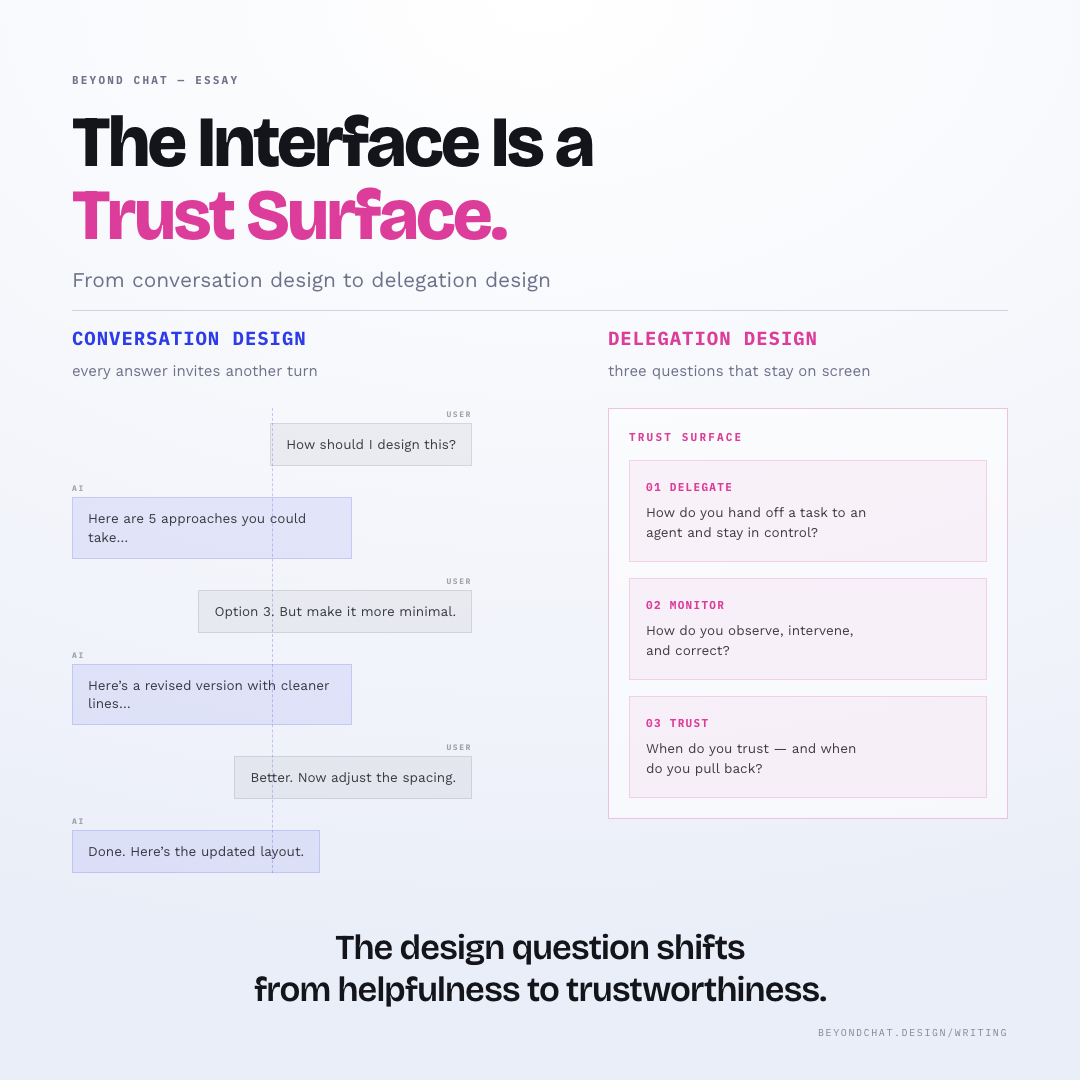
From the Essay
The design question shifts from helpfulness to trustworthiness.
The Argument
Every interface encodes an assumption about what the system is for. A text box and a response thread assume that the relationship between user and AI is conversational — one person asking, one system answering.
That assumption was roughly accurate in 2022. It is not accurate now. The systems being built today are running tools, maintaining memory, delegating to subagents, and making sequences of decisions that compound. The interface has not kept up.
The result is a structural mismatch: the user is managing a process, but the interface is designed for a conversation. Context gets lost. State gets hidden. Intervention becomes impossible. These are not edge cases — they are the predictable consequences of applying the wrong model.
Designed for
Single-turn Q&A
Question → Answer → Done
Now used for
Multi-step work
Plan → Execute → Supervise → Iterate
Context model
Ephemeral
Transcript only, no working state
Intervention
After the fact
Send another message
Structural Problem
Linear History
Every constraint you set in message 1 has to survive the entire session in text form. There is no working state — only the transcript. By message 20, the constraints are still there, but finding them requires scrolling, not looking.
Hidden State
You see the output. You do not see the 14 tool calls, 3 rejected drafts, and reasoning that produced it. The interface cannot tell you whether the answer is the result of careful research or a confident guess.
Weak Intervention
The only intervention point is a new message. If an agent is mid-operation, you cannot pause it, inspect the plan, or constrain its scope — you can only describe your concern and hope it was understood.
Pattern Responses
These patterns don't patch chat — they replace the assumption that a text thread is the right substrate for complex AI work.
Linear History
Important context disappears into scroll.
Hidden State
The system is doing more than the interface reveals.
Weak Intervention
Users need more than another message box.
Nine patterns. Three failure modes. One argument: the interface for AI work needs to be designed from scratch.
Explore All Patterns →