An agent that needs a decision either guesses silently or asks in prose, and the user answers four numbered questions in one paragraph that leaves one out — which the agent then fills with a guess.
← Back to patterns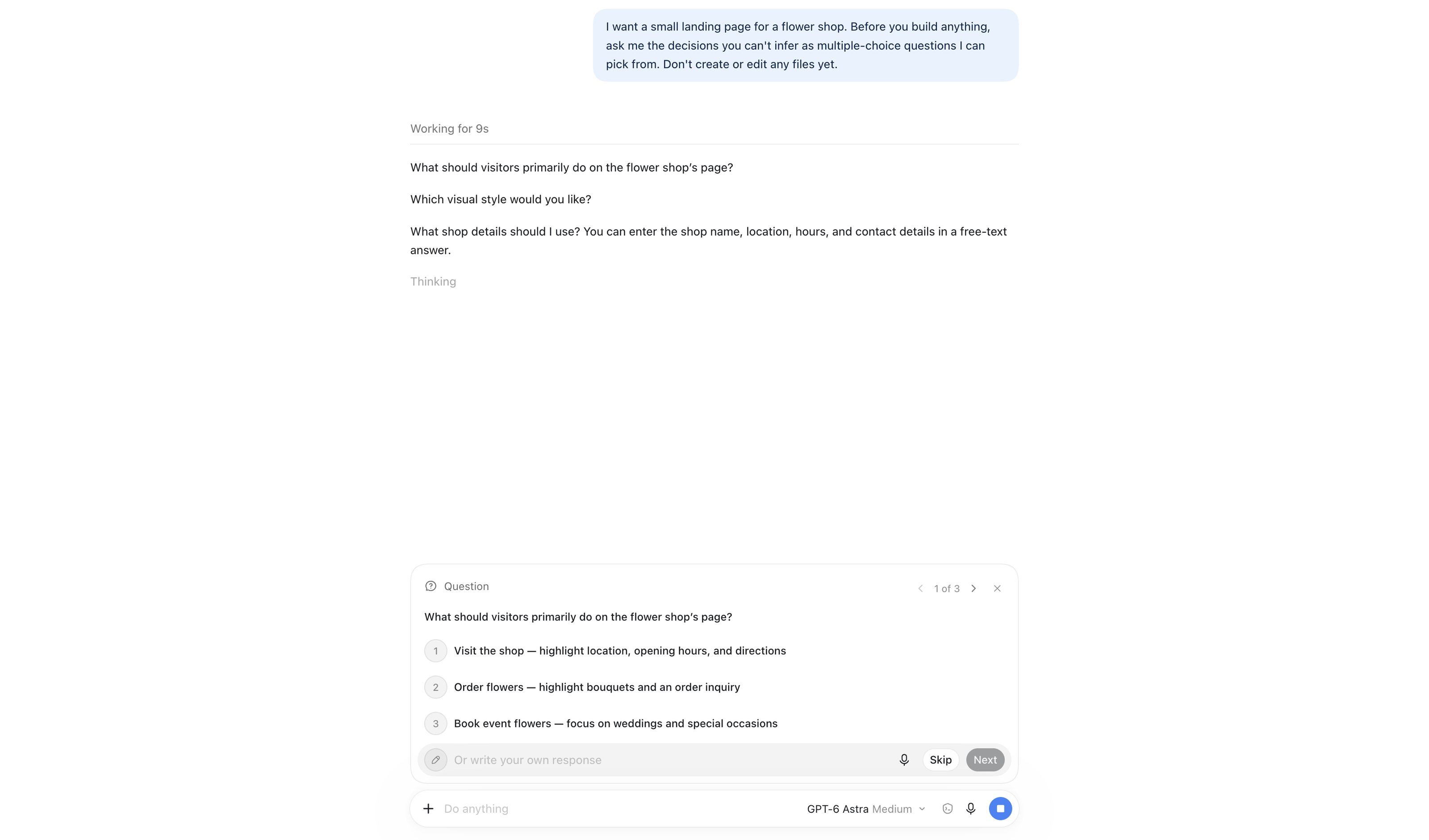
Agent Workflow
Clarifying Questions
Ask in options, not in paragraphs
An agent that needs a decision either guesses or asks in prose — four numbered questions the user answers in one paragraph that quietly leaves one out. Clarifying Questions gives every open decision its own card: two to four options, each with its consequence in one line, one marked as the recommendation, a free-text escape, and a skip that hands the call back to the agent on a stated default. Unlike Disambiguation Branch, which offers competing readings of the whole request, these are independent decisions the request left open; unlike Approval Gates, which asks yes or no on an action already chosen, they ask which action — mid-run, once the agent has read enough to know what is open.
Metaphor
Questionnaire
Interaction
Option Pick, Stepwise Answer, Skip to Default
Use case
Agent Kick-off, Mid-Run Decisions, Spec Gathering
Failure mode
Questions as Prose
Control mechanisms
Option Cards · Recommended Default · Free-Text Escape · Question Stepper
Reference examples
OpenAI Codex · Claude Code AskUserQuestion · Cursor 2.1 Clarifying Questions
Interactive Example
The chat default and the pattern, against each other on the same task. The demo is the comparison.
Four questions went out. Three came back, and nobody counted.
The agent reads the page, finds the footer and asks in prose: four numbered questions in one message. The reply is one paragraph, “footer is fine, use buttondown, and just show a thanks message inline”, answering one, two and four and never mentioning three. Opt-in is missing, and the next message ships single opt-in, the legally risky choice for an EU list, mentioned once in passing.
On the card, each open decision gets two or three options with the consequence in one line — Buttondown: already configured, VITE_NEWSLETTER_URL is set — one marked Recommended, and an Other field for whatever the list missed. A stepper counts what is still open, and steps 4 to 6 of the plan fill in as each answer lands, so you see what a choice will build before the run resumes.
The move that matters most is the least visible: Skip is not silence. Skipping opt-in applies the stated recommendation, double opt-in, and the receipt files it as a default rather than as your answer. Skip only that one and the run resumes with 3 answered, 1 defaulted, 0 guessed. The chat run had one guess in it, reported as if you had answered it.
Prose hands back answers you have to parse. A card hands back decisions you can count.
DOPE Lens
How this pattern improves AI interaction quality.
DirectabilityPrimary
Each decision is answered on its own card — pick an option, write your own, or skip — instead of inside one reply paragraph
Observability
A stepper shows how many decisions are open and which are answered: 2 of 4, not a wall of numbered prose
Predictability
Every question names its recommended default, so a skip is a known outcome rather than a silent guess
Explainability
Each option carries its trade-off in one line, so the choice is made against its consequence, not its label
Fit
Where it earns its place.
Use it
when
when
An agent reaches decisions it cannot infer, and a wrong guess costs a rerun or a revert.
Avoid
when
when
Running and redoing is cheaper than answering, or the open decision is one the user has no opinion on.
In the wild
Where this pattern already ships.
Real implementations from products users already know. Each entry shows how the pattern got applied — what shipped, where it sits in the product, what it traded off.
OpenAI Codex
OpenAI
In Plan mode Codex prefers a question tool: its open-source spec allows up to three questions, ideally one, each option with one line on impact or tradeoff, the recommended one first, plus a free-form row. If unanswered, the Plan mode prompt says to proceed on the recommendation. The Question tray with Skip and Next rests on a Sep 2026 capture, not on the spec; the terminal client has no Skip control, but lets you confirm submitting with questions unanswered. The same card shape as Claude Code; the questions also stay in the transcript as plain lines.
Visit OpenAI ↗
Claude Code AskUserQuestion
Anthropic
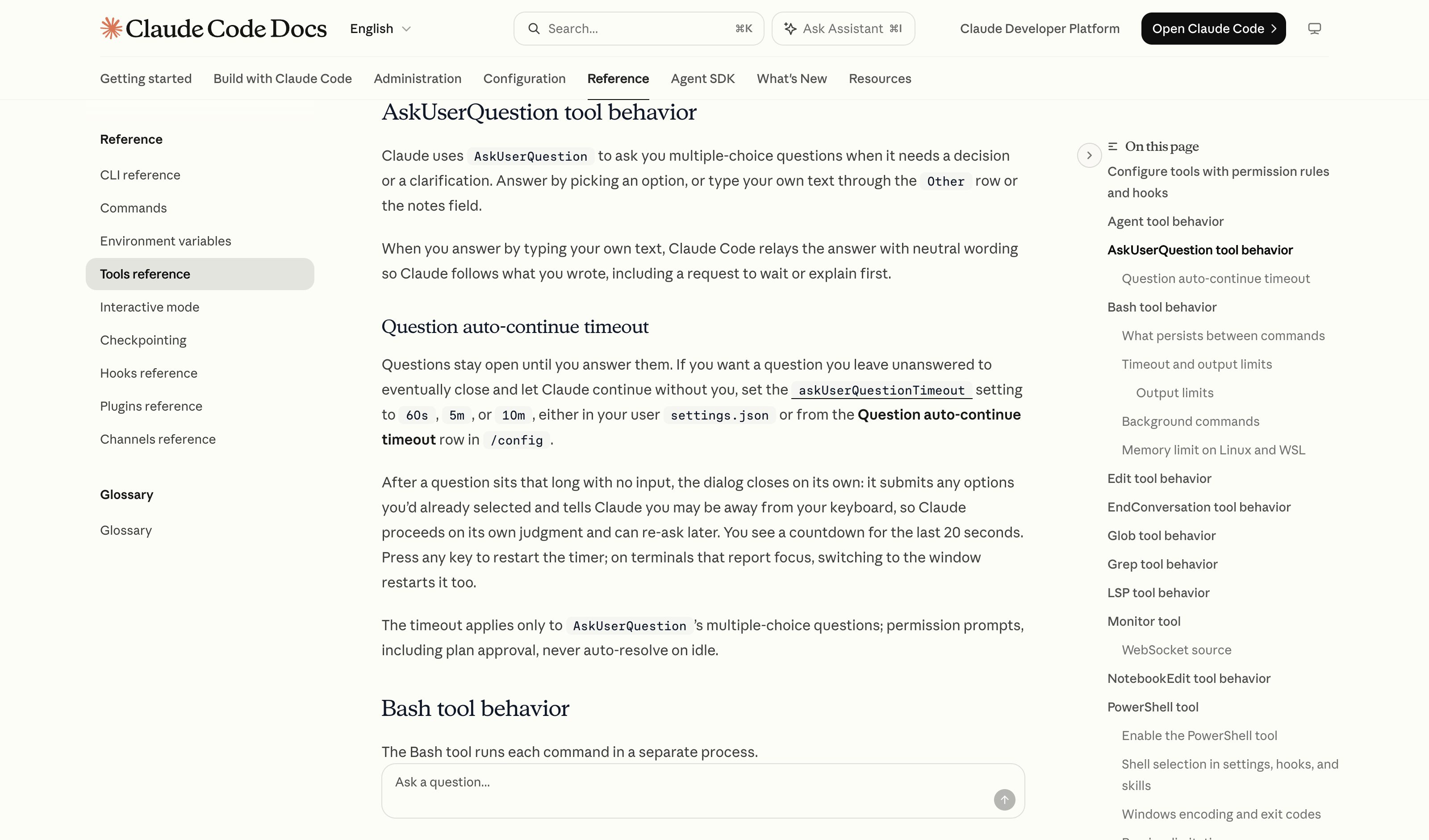
The agent asks through a tool, not in prose: multiple-choice questions when it needs a decision, answered by picking an option or typing into an Other row. The documented detail closest to a Skip is an opt-in auto-continue timeout: an unanswered question closes, submits whatever was already selected, and tells Claude you may be away, so it proceeds on its own judgment and can re-ask later. The fallback is Claude’s judgment, not a default named in advance.
Visit Anthropic ↗
Cursor 2.1 Clarifying Questions
Cursor
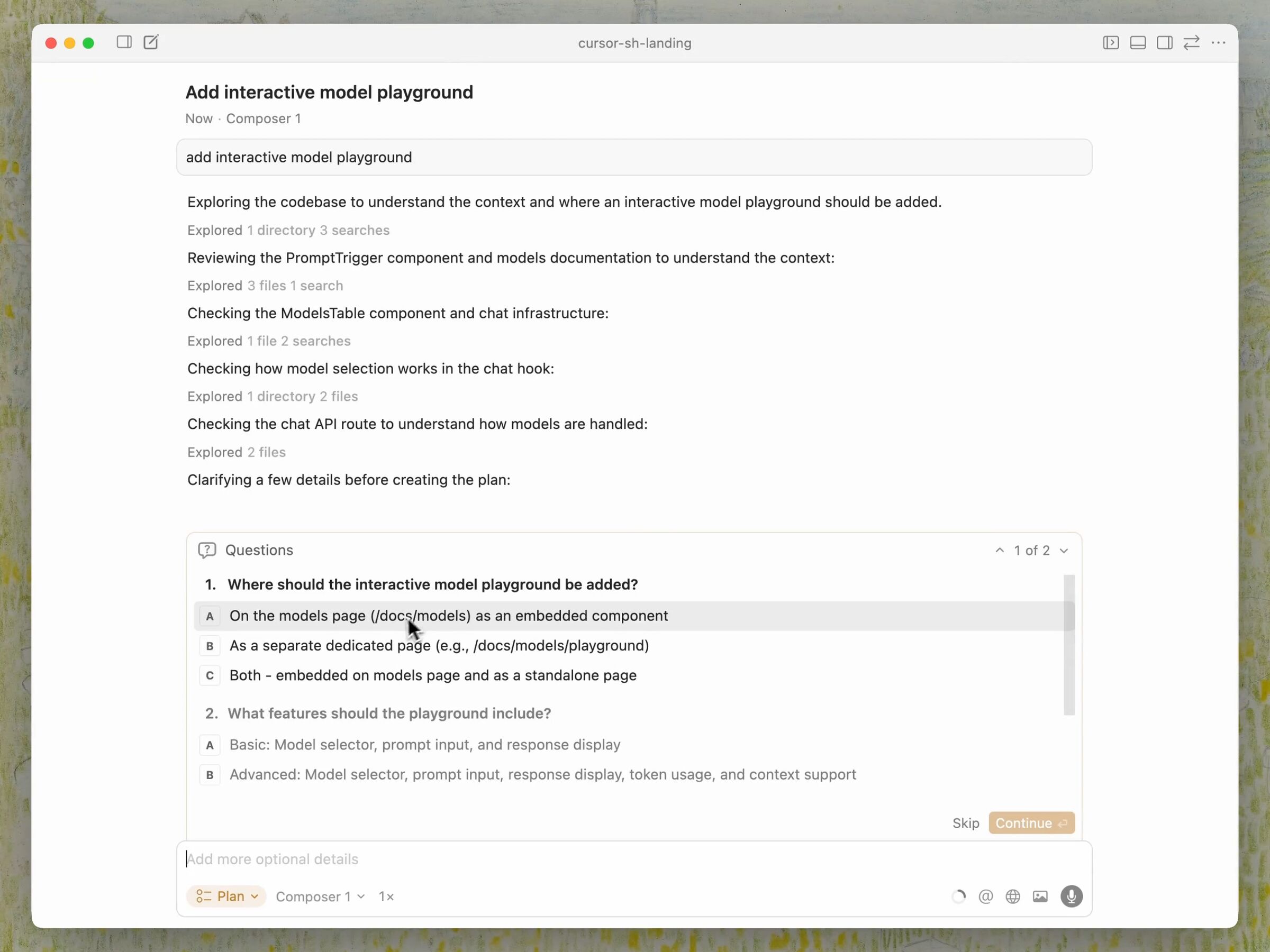
Nov 2025: Plan Mode responds with clarifying questions, answered in an interactive UI, before it writes the editable Markdown plan. The changelog does not specify the answer format or name a recommendation or skip. Cursor's ACP docs, for custom clients of its CLI agent, define a list of multiple-choice questions and a skipped outcome, with no recommendation, per-option consequence, free-text field or stated default. It asks independent questions rather than offering competing readings.
Visit Cursor ↗
Research Frame
Why this pattern exists, and where it breaks.
Give every open decision its own card with two to four consequence-labelled options, a recommended default, a free-text escape and a skip.
Chat asks in paragraphs and receives paragraphs, so the answer has to be parsed back into decisions — and a question the user forgot looks exactly like one they chose not to answer.
Asking what the agent could have inferred turns clarification into a form to fill in, and a recommendation that is always accepted becomes a rubber stamp.
Common questions
What people ask about this pattern.
When should I use the Clarifying Questions pattern?
+
An agent reaches decisions it cannot infer, and a wrong guess costs a rerun or a revert.
When should I avoid the Clarifying Questions pattern?
+
Running and redoing is cheaper than answering, or the open decision is one the user has no opinion on.
What problem does Clarifying Questions solve?
+
An agent that needs a decision either guesses silently or asks in prose, and the user answers four numbered questions in one paragraph that leaves one out — which the agent then fills with a guess.
Why is chat the wrong fit for this?
+
Chat asks in paragraphs and receives paragraphs, so the answer has to be parsed back into decisions — and a question the user forgot looks exactly like one they chose not to answer.